
You noticed it first as a tightness after a long sprint. A product launch, a tough deployment week, a stretch of back-to-back meetings with no time to get up from your chair.
You stretched, you took an ibuprofen, you booked a spa massage on the weekend. The pain dulled enough that you could ignore it through the next week.
But it came back. A little sooner this time. A little sharper.
Now it's there most mornings when you get out of bed. It's there at your standing desk, even when you remembered to use it. It's there on the commute home, and it follows you into the evening when all you want to do is rest.
You are not alone. At Curis 360 Physiotherapy Jayanagar, back pain is the single most common condition we treat among working professionals between 28 and 45. And the majority of them — the vast majority — waited far longer than they should have before coming in.
This article is for you. Specifically, if you are an IT professional working in or around Jayanagar, JP Nagar, BTM Layout, or Koramangala — and you have been telling yourself your back pain is "not that bad yet."
Why Jayanagar's IT Professionals Are Especially Vulnerable
The corridor from Jayanagar through JP Nagar to Koramangala and BTM Layout is one of Bengaluru's densest concentrations of technology professionals. Product managers, software engineers, data scientists, UX designers, QA teams, DevOps engineers — thousands of them spending 8, 10, sometimes 12 hours a day seated at laptops and workstations.
And the spine was not designed for this.
The human vertebral column evolved over millions of years for a creature that walked, ran, climbed, and crouched — changing positions constantly throughout the day. The lumbar spine, in particular, depends on movement to nourish its intervertebral discs. Discs have no direct blood supply — they receive nutrition through the compression and decompression of normal movement. A stationary lumbar spine is a slowly starving lumbar spine.
Here is what 8 hours of seated desk work does to your back:
- Disc pressure increases by 40% in a seated position compared to standing upright
- The lumbar multifidus — the deepest stabilising muscle of the spine — begins to show measurable atrophy within 4 weeks of predominantly sedentary activity
- The hip flexors shorten and tighten, pulling the pelvis into an anterior tilt that chronically loads the facet joints and posterior disc annulus
- The thoracic extensors switch off, causing the thoracic spine to round forward (kyphosis), which cascades compressive load downward into the lumbar spine
- The gluteal muscles inhibit — sitting on them for hours causes reciprocal neural inhibition — so the muscles most responsible for protecting the lumbar spine from load progressively weaken
By the time you feel pain, most of these processes have been underway for months or years.
The Story Nobody Talks About at the Office
His name, for our purposes, is Kiran. He is 33 years old, a senior software engineer at a product startup near Jayanagar 4th Block. He sits at his desk from 9 AM to 8 PM most days.
The back pain started two years ago. He called it "work stress" — something that would resolve when the project shipped. The project shipped. The pain didn't leave.
He bought an ergonomic chair. The pain shifted slightly but persisted. He started doing 30 minutes of yoga every morning, which helped for a few weeks, then stopped helping. He took a week off — the pain improved, then returned within days of sitting back at his desk.
Last month, Kiran bent down to pick up his laptop bag and felt a sudden, sharp pain in his lower back that shot down his left leg. He couldn't straighten up for several minutes.
He came to Curis 360 Jayanagar the following day.
Our assessment found a Grade 2 L4–L5 disc herniation with early nerve root compression — the direct consequence of two years of unaddressed lumbar instability, hip flexor tightness, and disc dehydration. What had started as a muscular back pain had, through two years of progressive loading on a weakening structural foundation, progressed to a disc injury that now required a 16-session rehabilitation programme.
If Kiran had come in at the six-month mark — when the pain was consistent but the disc was still intact — he would have needed 5–6 sessions.
Kiran knew he should have come earlier. He said exactly that at his first appointment.
We hear this every week.
7 Warning Signs That Your Back Pain Has Crossed the Line
These are the signals that mean your back pain is no longer a minor issue that will resolve with rest and ibuprofen. Each one warrants a physiotherapy assessment — not next month, not after the next project milestone, but this week.
Warning Sign 1: The Pain Has Been Present for More Than 3 Weeks
Acute muscular back pain from a single event — lifting something awkwardly, sleeping in an odd position — typically resolves within 10–14 days with gentle movement and normal activity.
If your back pain has been there for more than 3 weeks, it is no longer "acute." The pain generators are now embedded in a cycle of muscle guarding, postural compensation, and neural sensitisation that will not self-resolve. You need targeted physiotherapy.
Warning Sign 2: It's Worse in the Morning Than in the Evening
If your back is stiff and painful for 30 minutes or more after waking — and then gradually improves through the day — this is a classic pattern of inflammatory disc disease or early lumbar spondylosis. Morning stiffness is driven by inflammatory mediators that accumulate in the disc and facet joints overnight. This pattern does not respond to rest. It requires targeted anti-inflammatory movement and specific joint mobilisation.
Warning Sign 3: Sitting Makes It Significantly Worse
You may have noticed that your back is more comfortable when you walk around the office than when you sit. This is not a coincidence — it is diagnostic information.
Seated posture increases intradiscal pressure by 40% and loads the posterior disc annulus, which is where tears and herniations originate. If your pain clearly worsens with sitting beyond 20–30 minutes, there is almost certainly a disc component to your back pain. This is the stage to intervene — before the disc wall weakens further.
Warning Sign 4: You've Started Changing How You Move
You know what I mean. The way you roll out of bed in the morning instead of getting up normally. The way you hold the handrail on the stairs. The way you lean on the desk when you stand up. The careful, guarded movement that has become second nature.
These are compensatory movement patterns — and they are the body's short-term solution to a long-term problem. The problem with compensations is that they transfer load to structures that aren't designed to handle it. Your opposite hip. Your thoracic spine. Your knees. Within 6–12 months, we start seeing secondary problems in these areas too.
Warning Sign 5: The Pain Is Disrupting Your Sleep
If back pain wakes you from sleep, or prevents you from finding a comfortable sleeping position, it has crossed the threshold of a minor inconvenience. Sleep-disturbing pain indicates significant inflammatory activity in the spine's structures. It also matters because poor sleep profoundly impairs physical recovery — creating a vicious cycle where the pain prevents the sleep that would help the pain resolve.
Warning Sign 6: You Feel Pain, Tingling, or Heaviness in Your Buttock or Leg
This is the warning sign that most people minimise. "Oh, it's just my sciatica." As if sciatica is a minor thing.
Any symptom that travels from your lower back into your buttock, thigh, or lower leg — even a vague heaviness or occasional tingling — indicates nerve involvement. It means the disc, or another spinal structure, is beginning to encroach on a nerve root. This is not a sign to monitor. This is a sign to act on immediately, because nerve compression that continues untreated leads to chronic nerve sensitisation that is significantly harder to reverse.
Warning Sign 7: Pain Relief Methods That Used to Work Are Stopping Working
You used to be able to manage it with a good massage once a month. Then you needed it every two weeks. Now even the day after a massage, you're back to the same level of pain.
You used to get relief from ibuprofen. Now you need to take it every day, and even then, it barely touches the pain.
This escalating need for pain management is one of the clearest signs that the underlying structural issue is progressing. Massage and pain relief are not treating the cause — they are masking the signal. Your body has been trying to tell you something for months. Each time the signal returns faster and louder, it is telling you the message hasn't been received.
What Happens When IT Professionals Keep Waiting
We will be direct with you, because we respect your intelligence.
At 4–6 weeks of consistent back pain: The deep stabilising muscles of your lumbar spine begin to show measurable atrophy. The disc is accumulating cumulative micro-trauma. Physiotherapy at this stage: 4–8 sessions.
At 3–6 months of consistent back pain: Chronic pain pathways are beginning to develop in the nervous system. The compensatory movement patterns are well-established and creating secondary problems. Disc integrity is often compromised. Physiotherapy at this stage: 10–16 sessions.
At 12+ months of consistent back pain: Central sensitisation is present — the nervous system amplifies pain signals beyond what the tissue damage alone would generate. Sleep is often affected. Mental health impact (anxiety about movement, fear of re-injury) is significant. Physiotherapy at this stage: 16–30+ sessions, often with multidisciplinary input.
And at the end of all that — the treatment that could have been 6 sessions at the 6-week mark becomes a 6-month rehabilitation journey.
You have worked hard for your career. You manage complex systems. You solve hard problems every day. You would not leave a critical bug unpatched because it "hasn't caused a major incident yet."
Your spine deserves the same logic.
What the Best Back Pain Physiotherapy in Jayanagar Actually Looks Like
At Curis 360 Physiotherapy, Jayanagar, we see too many patients who have had generic physiotherapy elsewhere that didn't work — and given up on physiotherapy entirely as a result. We want to be clear about what evidence-based back pain treatment looks like, because it is very different from heat packs and generic back exercises.
Step 1: The Diagnostic Assessment (Session 1 — 45–60 minutes)
Your first session at Curis 360 Jayanagar is not a treatment session. It is a thorough clinical assessment covering:
- Postural analysis — identifying the specific postural faults that are loading your lumbar spine (anterior pelvic tilt, thoracic kyphosis, forward head carriage, valgus knee collapse during standing)
- Movement assessment — lumbar flexion, extension, and lateral bend range with symptom response
- Directional preference testing — identifying which movements centralise or peripheralise your symptoms (critical for disc-related back pain)
- Muscle length testing — hip flexors, hamstrings, thoracolumbar fascia
- Neurological screening — reflexes, sensation, muscle strength testing to identify nerve involvement
- Orthopaedic testing — SLR, prone instability test, segmental mobility assessment
At the end of this assessment, you will know exactly what is causing your pain — and exactly what your treatment plan involves.
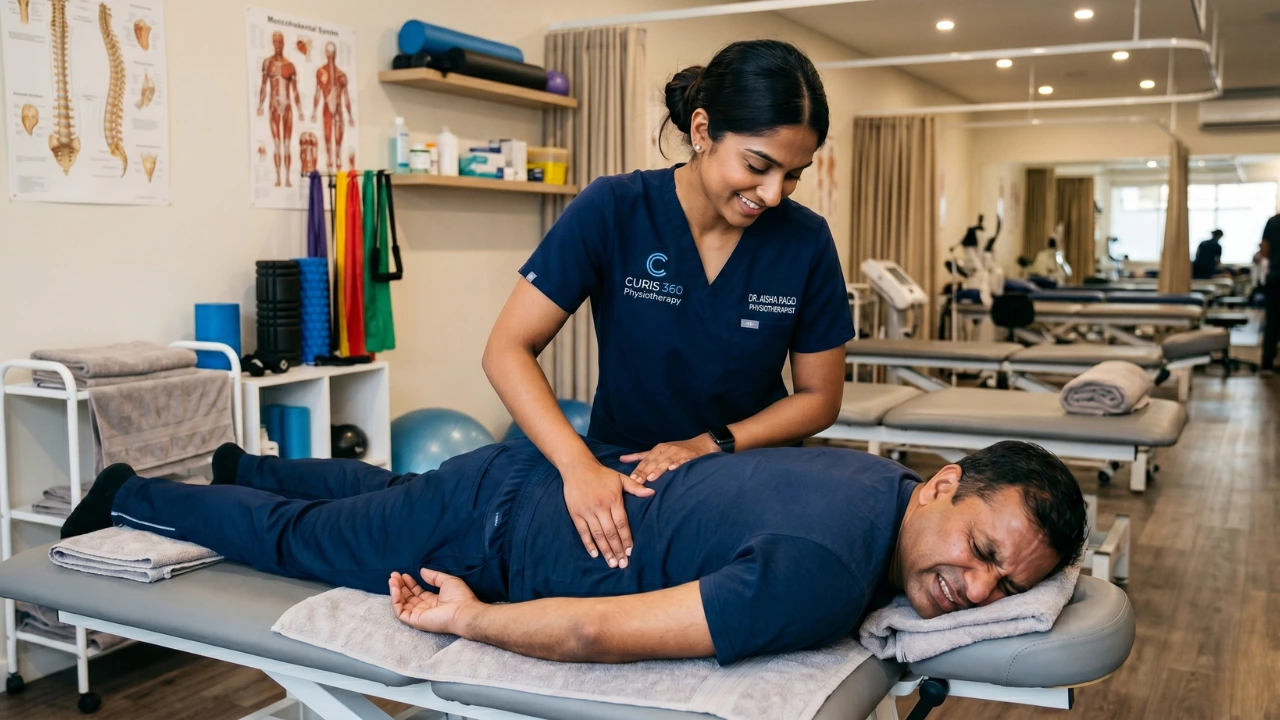
Step 2: Manual Therapy
Hands-on physiotherapy is irreplaceable for back pain. At Curis 360 Jayanagar, this includes:
- Maitland joint mobilisation — Graded posterior-anterior pressure on specific lumbar segments to restore normal segmental mobility and reduce facet joint pain
- Myofascial release — Targeted soft tissue release of the thoracolumbar fascia, quadratus lumborum, and deep lumbar extensors
- Dry needling — For trigger point deactivation in chronically tight lumbar and gluteal muscles
- Sacroiliac joint mobilisation — Where the SI joint is a contributing factor
Step 3: Electrotherapy for Pain Management
- Interferential Therapy (IFT) — Deep electrical stimulation that reduces disc and facet joint inflammation without medication
- Therapeutic Ultrasound — For soft tissue healing and deep heat at the disc level
- TENS — Taught as a home pain-management strategy between sessions
Step 4: Targeted Exercise Rehabilitation
This is the component that separates adequate physiotherapy from excellent physiotherapy. The exercise programme at Curis 360 Jayanagar is entirely individualised to your diagnosis and functional capacity.
Phase 1 — Pain management and core activation (Sessions 1–4):
- McKenzie extension or flexion protocol (based on directional preference)
- Deep core activation: transversus abdominis and multifidus recruitment
- Hip flexor stretching programme
Phase 2 — Stability and strength (Sessions 5–10):
- Functional stabilisation: dead bug, bird-dog, modified plank progressions
- Gluteal activation: bridges, clams, side-lying hip abduction
- Hip hinge mechanics: teaching the fundamental movement pattern that most desk workers have lost
Phase 3 — Return to full function (Sessions 10+):
- Dynamic loading progressions
- Workplace-specific movement training (how to sit, stand, lift correctly — specific to your workstation setup)
- Home maintenance programme to prevent recurrence
Step 5: Ergonomic Assessment and Workplace Guidance
Every back pain patient at Curis 360 Jayanagar receives specific ergonomic recommendations for their workspace — because physiotherapy without addressing the 8 hours a day you spend at your desk is like patching a roof while leaving the window open.
This includes screen height, chair height and lumbar support, keyboard position, lighting, and — critically — a movement prescription for the workday: when to stand, when to walk, and which specific exercises to do at your desk.
Proof That Recovery Is Possible
"I was at the point where I couldn't sit through a one-hour meeting without getting up. 9 sessions at Curis 360 Jayanagar and I'm back to full days at my desk without pain. I only wish I hadn't waited 8 months." — Preethi R., Software Lead, JP Nagar
"Dr. Ponkhi's team found that my back pain was coming from my hip — not my back. Nobody had figured that out in 6 months of treatment elsewhere. Fixed in 7 sessions." — Rajan K., Product Manager, BTM Layout
"I thought I'd need surgery. The MRI looked bad. Curis 360 got me back to running in 12 weeks without surgery. The best decision I made was booking the assessment." — Deepak N., Senior Developer, Koramangala
Recovery is not just possible — it is the expected outcome with the right physiotherapy. You do not have to accept back pain as a permanent cost of an office career.
Frequently Asked Questions
How quickly can I expect improvement from back pain physiotherapy at Curis 360 Jayanagar? Most patients with recent-onset (under 6 weeks) mechanical back pain notice significant improvement within the first 2–3 sessions. Chronic back pain (3+ months) typically shows clear progress by session 5–6. You will never complete a session at Curis 360 without knowing exactly what happened and what the next step is.
I've already had physiotherapy elsewhere and it didn't help. Should I try again? Yes — with important caveats. Generic back physiotherapy (heat, TENS, standard exercises) frequently fails because it does not address the specific mechanical diagnosis. At Curis 360 Jayanagar, we perform a detailed assessment first and base the treatment on your specific directional preference and underlying cause. Many of our most successful outcomes are patients who had previously "failed" physiotherapy elsewhere.
Do I need to take time off work for physiotherapy? No. Sessions are 45–60 minutes and available from 8 AM — most patients come before work, at lunch, or after work. You can continue working throughout your treatment programme.
What is the cost of back pain physiotherapy at Curis 360 Jayanagar? Sessions start from ₹650, and the one-time ₹400 consultation is waived when you begin treatment the same day. No hidden package fees — you pay per session. Book your assessment online or call +91 78998 44360.
What is the address of Curis 360 Jayanagar? Curis 360 Physiotherapy Jayanagar is located at 7th Block, Jayanagar, KR Road, Bengaluru — central to JP Nagar, BTM Layout, Koramangala, and Banashankari. Dedicated parking available. Lift access for all patients.
The Only Question That Matters Now
You've read the seven warning signs. You recognise at least some of them.
You've read about what happens when professionals in your situation keep waiting.
You've read about what recovery looks like when the right physiotherapy is applied at the right time.
There is one question left: what are you going to do today?
Not next week. Not after the current sprint ends. Not when things calm down.
Because things don't calm down. The workload doesn't reduce. The disc doesn't wait. And every day that passes is a day of further cumulative load on a spine that has already been telling you, in increasingly clear terms, that it needs help.
Book your back pain assessment at Curis 360 Jayanagar today. Sessions from ₹650. Monday–Saturday, 8 AM–8:30 PM. No referral needed. +91 78998 44360.
Your career demands your best performance. Your back makes that possible. Protect it.

Dr. Ponkhi Sharma PT
Clinical Director at Curis 360. Specializing in advanced rehabilitation, evidence-based manual therapy, and holistic patient care in Bengaluru.
View Full Clinical Profile